 Bishop Cotton School, Shimla became a space for reflection on India’s agricultural transformation as Priyambada Jayakumar presented and discussed her acclaimed book M. S. Swaminathan – The Man Who Fed India. The session brought together students, educators and policy voices to revisit the life and legacy of one of India’s most influential scientists, MS Swaminathan, widely regarded as the architect of the Green Revolution.
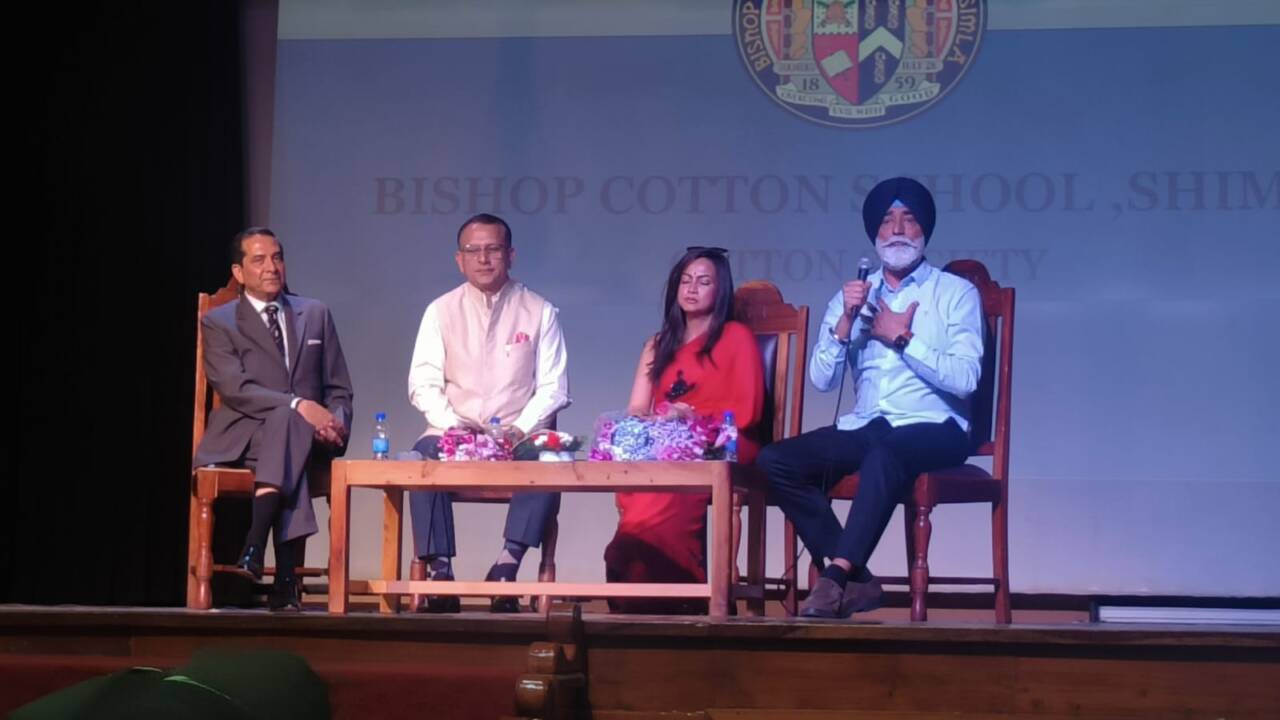
The conversation was moderated by noted author and historian Raaja Bhasin, whose balanced and insightful facilitation guided a layered discussion between science, policy and ground realities in Indian agriculture. The panel featured Sukhpal Singh Khaira, MLA and President of the All India Kisan Congress and Amit Singh Chauhan, National Horticulture Board Director.
The session highlighted how Swaminathan’s work transformed India’s journey from food scarcity to self-sufficiency. Priyambada underlined how “M.S.” bridged science and policy with an unwavering focus on food and nutrition security, rooted in the belief that access to food is fundamental to human progress. She also shared that her insights were shaped by personal interactions with M.S. Swaminathan, whom she had known since childhood, allowing her to engage closely with his life and experiences to bring a deeply personal perspective to the biography.
The biography traces Swaminathan’s journey from Kumbakonam to global recognition, including his collaboration with Nobel Laureate Norman Borlaug and his multifaceted roles as a conservationist, institution builder, diplomat, and lifelong advocate of sustainable agriculture. His accolades—including the World Food Prize, Ramon Magsaysay Award, and the Bharat Ratna (2024)—were referenced as markers of a lifetime dedicated to ending hunger.
During the panel discussion, Sukhpal Singh Khaira raised concerns grounded in farmer realities, stating that despite Swaminathan’s widely acknowledged recommendations, implementation gaps remain significant. He emphasised that issues such as Minimum Support Price (MSP) reform continue to directly impact farmer livelihoods, particularly in Punjab and other agrarian states.
Amit Singh Chauhan acknowledged the challenges on the ground while noting that institutional efforts are ongoing to improve agricultural outcomes. He pointed to structural constraints, including population pressures, food wastage, and governance gaps, as contributing factors affecting policy impact.
The discussion also touched upon broader concerns raised by students, including India’s dependence on pulse imports and the inability of farmers to influence pricing mechanisms for their produce. Questions from students such as Rajveer Kochar reflected curiosity about policy responses and agricultural self-reliance.
Overall, the session emerged as an engaging and thought-provoking exchange that not only honoured the legacy of M.S. Swaminathan but also encouraged critical thinking among students about the future of Indian agriculture. For the young audience at Cotton School, the discussion served as both an introduction to a towering scientific legacy and a reminder of the complex realities shaping India’s food systems today.
#Education #Agriculture #GreenRevolution #MSSwaminathan #Shimla #BookDiscussion #FoodSecurity #Policy #BishopCottonSchool #IndianFarming


Nurturing Creativity – Keekli Charitable Trust, Shimla