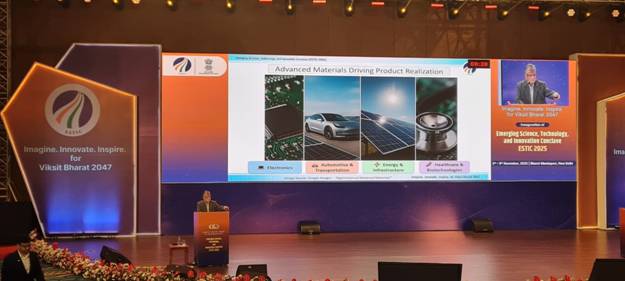
 The Council of Scientific and Industrial Research (CSIR) showcased India’s strides in advanced materials and manufacturing during a high-impact technical session on Day 3 of the Empowering Science, Technology and Innovation Conclave (ESTIC) 2025. The session brought together top scientists, innovators, and entrepreneurs to discuss transformative technologies shaping the nation’s innovation ecosystem.
The plenary session, chaired by Dr. (Mrs) N. Kalaiselvi, Director General of CSIR and Secretary, DSIR, explored how advanced materials are redefining product development, industrial design, and sustainability. Dr. Kalaiselvi emphasized that breakthroughs in materials science, clean energy, biotechnology, and emerging technologies will be central to achieving Viksit Bharat 2047, positioning India as a technologically empowered, self-reliant, and innovation-driven nation.
Highlighting the shift from traditional materials to engineered, high-performance structures, Prof. Giridhar Udapi Rao Kulkarni, Former President, JNCASR, Bengaluru, illustrated how precision-designed semiconductors, composites, and smart polymers are enabling next-generation technologies. He stressed the continuum: Science → Innovation → Manufacturing → Product, as a driver of India’s technological transformation.
The session featured inspiring presentations by industry and academic leaders:
-
Pawan Kumar Chandana, CEO of Skyroot Aerospace, spoke on “Elevating Aerospace: The Frontier of Advanced Composites and 3D Printing,” highlighting India’s first all-carbon launch vehicle, Vikram-1.
-
Rajashri Teli, MD of Innovative Projects Pvt. Ltd., discussed the role of design precision and women-led leadership in manufacturing.
-
Prof. T. Pradeep, IIT Madras, presented on scalable nanotechnologies for clean water and sustainable solutions.
-
Prof. B. S. Murty, Raman Research Institute, outlined advances in semiconductors, photonics, and quantum computing in “Building India’s Quantum Edge.”
The conclave reinforced CSIR’s commitment to advancing India’s scientific and technological frontiers. By fostering collaboration between researchers, industry, and policymakers, ESTIC 2025 is accelerating India’s transition to a knowledge-driven economy. Applied research in advanced materials and manufacturing, as showcased at the conclave, will be pivotal in building a self-reliant, globally competitive India by 2047.
Sponsored
Nurturing Creativity – Keekli Charitable Trust, Shimla