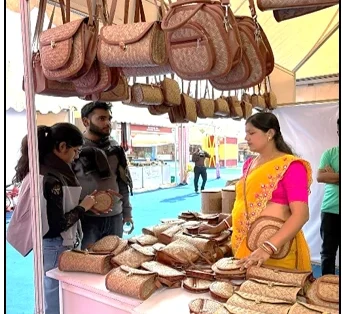
 The journey of a simple bamboo bag from a village workshop to urban markets highlights a major economic shift across India. Decisive policy changes, technological integration, and targeted government support are transforming localized bamboo crafts into modern, scalable enterprises.
For decades, bamboo’s commercial growth was restricted by an outdated regulatory classification that treated it as a tree. The landmark 2017 reform removed bamboo from this classification, allowing communities and private enterprises to harvest, process, and transport it freely. This change catalyzed nationwide innovation, particularly across the Northeast, where bamboo has become a key driver of employment and industrial growth.
Today, bamboo is expanding far beyond basic handicrafts into contemporary design, agriculture, and manufacturing. Sikkimese designer Chimi Ongmu Bhutia’s Lagstal Design Studio produces modern furniture and decor, while innovators in Tripura integrate advanced processing technology. In Nagaland, Self-Help Groups (SHGs) develop bamboo-based foods, and Mizoram advances scientific cultivation through tissue culture. Supported by the National Bamboo Mission, farmers in Madhya Pradesh are replacing unprofitable crops with bamboo saplings while intercropping chili, ginger, and garlic.
Technological support from institutions like NECTAR has increased raw bamboo’s value addition from 10% to 70%, generating roughly 30 million man-days of annual employment. Engineered bamboo—a high-strength composite—is replacing traditional construction materials, with over 4.2 million square feet of engineered structures built for disaster rehabilitation and 576 school classrooms constructed in Chhattisgarh.
The expanding value chain has also unlocked vital economic opportunities for women’s SHGs. The Gadchiroli Agarbatti Project in Maharashtra established 32 processing centers employing over 1,100 people—90% of whom are women—quadrupling their annual work days. Additionally, training initiatives by CSIR-NEERI in Nagpur instruct women SHGs on processing bamboo cultivated on reclaimed fly ash dumps, turning degraded landscapes into productive economic hubs.
India’s Indigenous Technology Revolutionizes Road Construction
Sponsored

Nurturing Creativity – Keekli Charitable Trust, Shimla