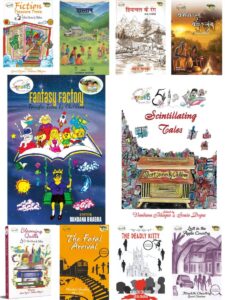
A Young Reader, Kavyanadhi in Conversation with Lalitha Ramanathan
 Kavyanadhi Satish is an eleven-year-old who loves reading books and writing. Here, she interviews Lalitha Ramanathan, the author of Kanmani & Co. Set in a South Indian village, Kanmani & Co. follows a group of children and their daily adventures. Their days are shaped by local festivals, shared responsibilities, outdoor play, and the strong sense of community in a rustic setting. Frogs, curiosity, and mischief make frequent appearances.

At its heart, the book explores how children learn through observation, imagination, and resilience rather than through constant instruction or screens. It celebrates everyday village life while inviting young readers into a world grounded in empathy, connection to nature, and joy in the ordinary.
Three copies of Kanmani & Co. were sent to Shimla by the author for the Mimansa 2026 – Children’s Literature Festival, to be given as prizes to young readers and to encourage and promote reading among children.
Kavyanadhi: Hi! I have enjoyed reading all about Kanmani, her friends and their exploits in Kanmani & Co. So, my first question is: What inspired you to write the book?
 Lalitha: A lot of this inspiration was from my childhood, where I had a lot of fun playing games, meeting my grandparents, and enjoying a childhood that was free of devices and digital influences. So, I wanted to recreate that magic of a childhood where we thought of our own games, we tried to solve our problems creatively. And… we were just happy in our own happy, imaginary world, right? So, I wanted to bring that innocence, that magic, that joy, in a way like creating the magic of a, like, Famous Five in today’s contemporary setting. Yeah, that was the whole idea.
Kavyanadhi: When is the story set?
Lalitha: It is set in a more recent time, but it is set in a rural area. So, it is set in the current time, because it also addresses current problems like plastic pollution and illiteracy and all of that, but it is set in a contemporary time zone and with that kind of rustic feel.
Kavyanadhi: Yeah. So, like, the names in the book were very interesting and, uh, very pleasing to the ears. So, how did you come up with them?
Lalitha: Ha, ha… So, it’s weird, right? That writers sometimes have no reason—the name just comes and you fall in love with the name and it just kind of sticks. So, when I wanted my central character, I wanted something like an endearing name. Like, um, you know, when we address young children, we say Kanmani or ‘sweet child’, or, you know, some kind of endearing connection. So, that’s how that name Kanmani came into being.
And the others… Seethalakshmi is actually a nod to my grandmother. Her name is Seethalakshmi, so I wanted her to be in the book in some form. And somehow the other names just fell into place. Actually, the cat is the most interesting name. Initially, I wanted to name it after a Rajinikanth movie. So, I wanted to call him Baashha. I don’t know if you’ve ever watched any of Rajinikanth’s movies. I wanted to call the cat Baashha, like after a mafia boss.
But the publishers refused. They did not want any characters named after real-life persons or from real-life movies. So, then I thought, let’s have a twist on the name. Because the cat is considered inauspicious or superstitious, so let’s call him Blessing, right? Let’s call him Varam. Varam means boon or blessing. So, Kanmani was one of my favourite names, Seetha is a tribute to my grandmother, the other names just kind of happened, and Varam had a particular reason.
Kavyanadhi: Is there any special message you want the readers to get from your book?
Lalitha: Of course. For all the young readers, the important message is: be curious, ask questions, then just play a lot and try to solve problems creatively, like out of devices. See how you can contribute or make a difference to this world without just relying on technology. And the importance of play, the importance of reliving that magic of a childhood. All that is a bit hard nowadays because you’re so busy with your schedules, you’ve got classes, you’ve got deadlines. So then, how do we recreate that innocence and that magic of that childhood? Yeah, so that was the main thing—dear children, be curious, enjoy play, and solve your problems creatively. That would be my message.
Kavyanadhi: Yeah, that’s a very interesting message. One that everyone needs. Why did you make a lot of short stories instead of just writing one long story?
Lalitha: That is a very good question. So, when I first started this book, this is my first children’s book. At first, I thought I’d write just one continuous adventure. But then I thought, ‘Okay, there’s a whole community of people in a village.’ There’s so many of them—they’re like one whole big family. You have a neighbour who’s a little helper, then you have a coconut climber, you have the village chief, you have the panchayat members… There’s so many, right? I just felt that it might be interesting to introduce this cast to give that full, ample coverage and to ensure that everyone gets familiar with the community setup. And it didn’t seem to be such a good idea to overload one story with everything. So, I said, “Okay, story by story, let me introduce these characters and what they do in the village to emphasize that community aspect, right?”
So, you have one story with the hairdresser, then you have one story with the coconut climber, one story with the village cook, and then one story with someone else… So then, little by little, I introduce each one of the characters. But I do hope that if there is a series, then I will write one continuous story focusing on just a few characters. But this is just to set up the stage for any future books and to set the tone.
Kavyanadhi: And why did you choose a cat as the faithful partner? Most people choose dogs, thinking that they’re more loyal and all.
Lalitha: (laughs) So, I’m a cat person. Okay, technically I like dogs and cats, but I have a teenage daughter, but when she was young, she loved cats! And for no reason! She’d go, ‘Kitty, kitty, kitty, kitty, kitty,’ crazy about cats. And I think some of that rubbed off on me. First, I used to think that cats are very cold, unlike dogs that have a friendly energy. I took my daughter to these cat cafés where you can actually play with cats. And then I saw they are both so cute and they do show affection, but probably not openly. And then evolved to really like cats! (laughs) Thanks to my daughter, I’m now falling in love with cats, and yeah, now I’m a cat person.
Kavyanadhi: Even I like cats.
Lalitha: (laughs) My daughter has a very specific reason for liking cats. She says that dogs are great, but cats respect space and privacy, and, you know? It’s like, ‘Okay, you don’t want to go out for a walk? Okay, fine, I understand.’ So, you know, that kind of reserved energy to them.
Kavyanadhi: Indeed, cats give you space. Onto another aspect now, why did you choose Sreejith to be the sports master’s—Mr. Damodaran Sir’s—son with a disability? It’s a very interesting combination.
Lalitha: Honestly, I just think that there aren’t enough books with differently abled children at the forefront, right? Or rather, I think there should be many, many more books so that we understand what it means, what inclusivity means, because otherwise it’s just one word. So, for example, you have a child who wants to play sports, but isn’t on the same playing field.
I want young readers to read this book and say, ‘How can we make a difference?’ ‘How can we be more accepting?’ or ‘How can we engage in this conversation around inclusivity so that everyone gets an equal opportunity?’ Right? Because, through no fault of Sreejith’s, he has something that’s setting him back. So, how do we bring him forward so that he’s able to follow his passion?
So, it was mainly about having this conversation. And also, I would love to see more and more books with… and I’m sure some of the authors have already written a few, but I want more and more books with a mainstream protagonist who’s able to overcome his challenges and, you know, is at par with everyone else.
Kavyanadhi: Yes, I’d like that too. So, why did you choose to set the story in a town called Maripuram, which worships Mariamman?
Lalitha: That’s a very good question. Honestly, there is a story behind that.
So, I grew up in Kerala. My mother tongue is Tamil, but we grew up in Kerala. Generations ago, my grandparents migrated from Tamil Nadu to Kerala, so we’re settled in Kerala. But our family temple—we call it the Kuladeivam Kovil, the Kuladevi’s temple—that’s in Tamil Nadu.
So, every year, my cousins and I, along with my grandparents, would do this road trip from Kerala to Tirunelveli in a car. And that’s one of the sweetest memories of childhood because, as cousins, we used to play games in the car, we’d have snacks through the whole drive. It used to be amazing because of the green fields, the wind blowing, and it was like full masti. We had so much fun.
We’d go to the temple of Durga. And if you go around these villages in Tamil Nadu, almost every village has a Mariamman temple or a Madurai Veeran temple. So, depending on where you go, they have this form, some form of Parvati, that they worship, yeah?
And then I was inspired because I haven’t gone to the temple in a few years.
I was like, I want to recreate that. So, a Mariamman temple, and the village, let it be named after Mariamman, so let’s call it Maripuram. And then that becomes a kind of focal hub, and all the activities of the village revolve around it.
In a way, I was recreating that memory from childhood, which is that visit to that rural area where there’s a pond, children are running around… There used to be peacocks in that village, in that temple. So, it was just trying to recreate that memory and then bringing it to life as my setting. And I thought it would be a different setting for children who have not often gone to villages or not had the chance to explore rural India.
Kavyanadhi: So, it’s a very nice setting. I liked it, especially for people who live in the city to experience something new.
Lalitha: Thank you very much.
Kavyanadhi: So, what is your favourite character or scene?
Lalitha: Okay, um… my favourite character is Kanmani, obviously. My favourite scene is actually one of the first chapters, where Kanmani is teaching her grandmother to write, to sign her name. That’s actually based on a real-life incident. It’s based on the relationship between my grandmother and me. So, Kanmani’s Thatha and Paati are modelled after my grandparents.
As I said, I lived in Kerala, and there was an instance where it was just me and my grandparents. My parents were travelling, and I had gotten a test result. And the teacher said, ‘Please get the signature and come back.’ The signature of the parents.
My Paati did not know how to sign in English. She knew how to sign in Tamil, but she did not know how to sign in English or Malayalam.
So, I was like, ‘If you sign in Tamil, people are going to laugh. Can I teach you how to sign your name?’ So, my Paati said, ‘Yeah, okay, that’s cool. You teach me how to sign.’ That moment, I still remember very clearly—how I helped my grandmother to write. And I wanted to bring that alive—that tender moment of the grandmother who’s been teaching the granddaughter all her life, and now this is one opportunity where the roles are reversed.
And the granddaughter is also fulfilling years of longing because the grandmother really wanted to study, but she didn’t get a chance. So, for me, that scene is my favourite because I think, as writers, we relate most to the scenes that have happened as a lived experience, right? Something has happened in our life which we cherish, it’s a fond memory, it’s a bit of a sweet memory, and then we kind of make it immortal through our work. And this moment for me is that.
Kavyanadhi: True, tender and a lived experience, I get it. So, another question is: Why did you make Palani love frogs? (laughs)
Lalitha: (laughs) Why not? So, here’s the thing, right? I wanted to create a very quirky character. Someone who’s like the backbencher, prankster, but he’s also very smart. He’s resilient, he’s smart, he’d be the first person to come up with an innovation.
And I said, ‘Okay, I need him to have an unusual pet,’ right? A totally unusual pet, not a cat or a dog or a bird.
First, I thought I’d do turtles, then I thought, ‘No, turtles don’t have that much personality.’ Then I thought of a frog. It’s going to be jumping everywhere; he’s going to come everywhere. And then that idea took seed in my mind. There’s so much I can do with jumping frogs. It can create chaos, and Palani is synonymous with chaos. So then, it seemed the perfect pet for him. And they’re also a football-obsessed village, so I thought, ‘Okay, fine, let’s name them after footballers.’ And yeah, that’s how the whole thing happened. Just a quirk, and it kind of matches his personality.
Kavyanadhi: I was going to ask why you chose Kanmani to live with her grandparents for a long time, but I think I kind of understand that now.
Lalitha: There was a certain period where I had to stay with my grandparents because my parents had to travel, so I stayed with them for a couple of years, and that’s the experience that’s been modelled here, yeah. And that bond and that relationship that grandchildren have with grandparents.
Kavyanadhi: Thank you. That’s all the questions I have.
Lalitha: Okay, that was quick! But hey, very well-prepared! I mean, I just love the depth of thought and the fact that you’ve really read and loved the book, and thank you so much for such a detailed analysis. I know it’s not easy to come up with questions after reading, but you did a great job.
Kavyanadhi: Thank you!
(Lalitha Ramanathan is a finance manager-turned-author. She is an I.I.T. Delhi alumnus and has worked with a global F.M.C.G. giant in the finance department. Her short stories feature in over fifteen anthologies and on many online platforms. She is also a regular columnist for Hitavada Summer Splash, Children’s World, and Dimdima. Parenting Unplugged: The Drama Mama Diaries is her debut with Om Books International (2025). Her second book, Kanmani & Co., is a middle-grade fiction title with Scholastic India. While originally from India, Lalitha has made a home for herself in Singapore. The library is her happy place; her book club comes a close second.)

Nurturing Creativity – Keekli Charitable Trust, Shimla