
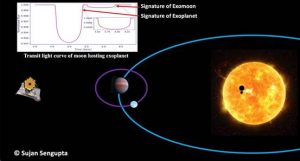
 PIB Delhi – Scientists have developed a model to trace the so far elusive exomoons – natural satellites that revolve around exoplanets (planets orbiting stars other than the Sun) with the help of the James Webb Space Telescope (JWST), launched in December 2021. This may also help detect habitable exo-moons in the future and understand new worlds beyond our own. So far, five thousand exoplanets — planets orbiting stars other than the Sun, have been discovered by using several ground-based and space telescopes such as Kepler, CoRoT, Spitzer, and Hubble space telescopes. However, the natural satellites or exomoon around any of these planets still remain untraced.
The Solar system is constituted of a large number of natural satellites with various sizes and mass, and many of them influence the ambient environment of the Solar planets. Therefore, a large number of exomoons are expected to be present, and they may play a crucial role in the habitability of rocky exoplanets in the habitable zone of their host stars. While most exoplanets are detected through photometric transit method, signals from exo-moons are too weak to detect mainly because of their extremely small size. Scientists at the Indian Institute of Astrophysics, Bangalore, an autonomous institute of the Department of Science and Technology, have demonstrated that the newly launched James Webb Space Telescope (JWST) is sufficiently powerful to detect the transit signal of exomoons in the photometric light curves of moon hosting exoplanets. Professor Sujan Sengupta and his graduate student Suman Saha have developed an analytical model that uses the radius and orbital properties of the host planet and its moon as parameters to model the photometric transit light curve of moon-hosting exoplanets by incorporating various possible orientations of the moon-planet-star system.
The co-alignment or non-coalignment of the orbits of the planet and the moon are used as parameters (using two angular parameters), and they can be used to model all the possible orbital alignments for a star-planet-moon system. Using these generic models and the analysis of photometric transit light curves of exoplanets that is being obtained by JWST, a large number of exomoons can be detected in near future. According to the researchers, an exo-moon around a gas giant planet like Jupiter in the habitable zone of the host star where temperature is appropriate for water to exist in liquid state may harbour life. Under favourable alignment of moon-planet-star, such exomoon may also be detected by JWST. The research has been accepted for publication in The Astrophysical Journal, which is published by the American Astronomical Society (AAS).


Nurturing Creativity – Keekli Charitable Trust, Shimla