 Researchers at the Jawaharlal Nehru Centre for Advanced Scientific Research (JNCASR) have discovered an unusual wave-like heat transport mechanism in a copper chalcogenide material, thallium copper selenide. Published in Science Advances, the breakthrough enables highly efficient conversion of industrial waste heat into electricity across power plants, steel mills, automobiles, and data centers.
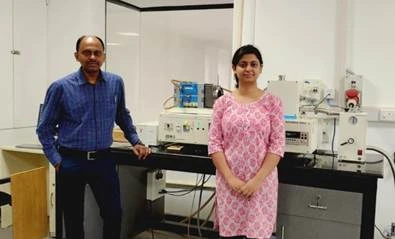
Led by Prof. Kanishka Biswas and his team, the study demonstrates how the complex crystal structure of the material confines copper ion movement. Unlike traditional materials where excessive ion diffusion causes structural instability, this confined dynamic disorder generates strong lattice anharmonicity without destroying the crystal framework.
Working with theoretical physicists Prof. Umesh V. Waghmare and Dr. Prasad V. Matukumilli, simulations showed that heat in this material travels through wave-like coherence—where phonons tunnel between localized vibrational states—rather than conventional particle-like movement.
This mechanism creates an ultralow thermal conductivity while maintaining high electronic performance, producing an exceptional thermoelectric figure of merit score of 1.7. Beyond waste-heat harvesting, these findings offer new design pathways for thermal barrier coatings and quantum technology thermal management.
Sponsored
Nurturing Creativity – Keekli Charitable Trust, Shimla