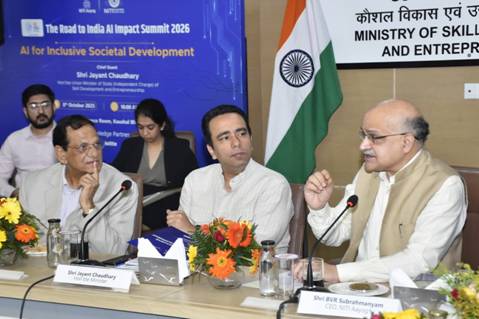
 Jayant Chaudhary, Minister of State (Independent Charge) for Skill Development & Entrepreneurship and Minister of State for Education, Government of India, unveiled NITI Aayog’s latest study, “AI for Inclusive Societal Development,” on October 8, 2025, in New Delhi. Developed under NITI Aayog’s Frontier Tech Hub in collaboration with Deloitte, this landmark report outlines a strategic roadmap for leveraging Artificial Intelligence (AI) and other frontier technologies to transform the lives and livelihoods of India’s 490 million informal workers.
The launch event was graced by key dignitaries including Suman Bery, Vice Chairperson of NITI Aayog; B.V.R. Subrahmanyam, CEO of NITI Aayog; Debashree Mukherjee, Secretary, Ministry of Skill Development and Entrepreneurship; Vandana Gurnani, Secretary, Ministry of Labour and Employment; S. Krishnan, Secretary, Ministry of Electronics and IT; and Debjani Ghosh, Distinguished Fellow at NITI Aayog and Chief Architect of the Frontier Tech Hub. Their collective presence underlined the government’s commitment to building a collaborative, tech-driven ecosystem for inclusive growth.
Unlike global AI discourse that typically focuses on white-collar jobs and the formal economy, this study takes a ground-breaking turn by centering on the informal sector, which contributes nearly half of India’s GDP but remains largely excluded from formal systems of protection, opportunity, and skilling. The report presents a comprehensive framework to bridge this divide and integrate the informal workforce into India’s digital and economic mainstream.
Jayant Chaudhary emphasized that empowering informal workers is both a developmental necessity and a moral responsibility. He said, “Digital skilling in AI for workers aligns perfectly with our national skilling agenda. By leveraging frontier technologies to make learning adaptive, accessible, and demand-driven, we aim to ensure that every worker—from farmers and artisans to healthcare aides—can thrive in tomorrow’s digital economy.”
To translate this vision into action, NITI Aayog has proposed the Mission Digital ShramSetu, a national initiative designed to make AI and frontier technologies accessible, affordable, and impactful for every worker. The mission will address critical challenges such as financial insecurity, limited market access, lack of skilling, and absence of social protection. Through the use of AI, blockchain, and immersive learning tools, the initiative aims to empower informal workers with skills and digital tools that can boost productivity, incomes, and dignity of work.
Highlighting the urgency of action, the roadmap warns that without intervention, the average annual income of informal workers may stagnate at around $6,000 by 2047—significantly below the $14,500 threshold required for India to reach high-income status. The report thus calls for immediate and coordinated action to avoid long-term socio-economic consequences.
B.V.R. Subrahmanyam underscored the need for cross-sectoral collaboration. “If we are serious about transforming the lives of 490 million informal workers, collaboration is not optional—it is non-negotiable. We need focused R&D, affordable technology solutions, and a sustainable innovation ecosystem tailored to the informal sector,” he said.
Debjani Ghosh further emphasized that for India to achieve its $30 trillion Viksit Bharat 2047 aspiration, it is essential not to leave behind the informal workforce that forms the backbone of the nation’s economy. “AI won’t change lives on its own,” she noted. “We must build a deliberate roadmap and ecosystem that makes these technologies truly accessible. This report is unique because it brings the voices and needs of informal workers to the center of the AI conversation.”
Ultimately, the roadmap from NITI Aayog sends a strong message: the future of inclusive development lies not just in adopting advanced technologies, but in ensuring they serve every Indian, especially those at the margins. With collective intent and coordinated action, AI can become a powerful equalizer in India’s journey toward Viksit Bharat by 2047.
Sponsored
Nurturing Creativity – Keekli Charitable Trust, Shimla