
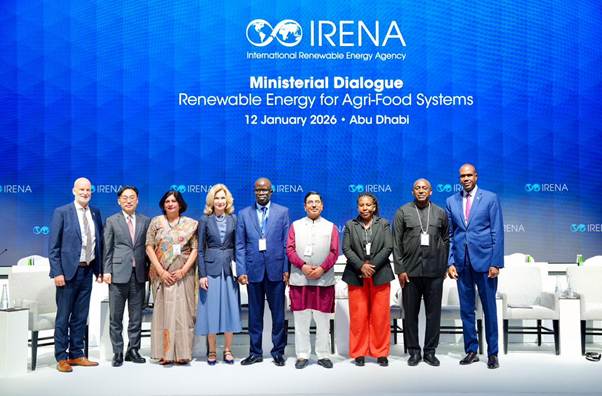
 Union Minister for New and Renewable Energy Pralhad Joshi reaffirmed India’s commitment to integrating renewable energy with agriculture and food systems to strengthen energy security, climate resilience and rural livelihoods. He was addressing the Inter-Ministerial Dialogue on Scaling Renewable Energy in Agrifood Systems, jointly organised by IRENA and FAO, in Abu Dhabi.
Highlighting India’s global responsibility as home to nearly one-sixth of humanity and one of the world’s largest food security programmes, the Minister said Indian farmers—traditionally revered as Annadata—are increasingly emerging as Urjadata, contributing both food and clean energy through decentralised renewable solutions.
Joshi emphasised that renewable energy provides a comprehensive solution to interconnected challenges of energy access, climate action, agricultural productivity and rural prosperity. India’s approach, he noted, combines ambitious targets with strong implementation, backed by robust policies, decentralised execution, inclusive design and close inter-ministerial coordination.
Detailing flagship initiatives, he highlighted the PM-KUSUM scheme, launched in 2019 to integrate solar energy into agriculture. As of late 2025, nearly one million standalone solar pumps have been installed and over 1.1 million grid-connected pumps solarised, adding more than 10,200 MW of capacity. The scheme has reduced diesel dependence, stabilised irrigation costs, lowered emissions and shifted support from recurring subsidies to durable asset creation.
The Minister also underlined measures to unlock private investment, including aggregation of agricultural demand through national schemes, surplus solar power sales by farmers, the National Bioenergy Programme for converting agricultural residues into energy, and the PM Surya Ghar Muft Bijli Yojana for rooftop solar—creating new income streams and enhancing rural energy security.
Looking ahead, Joshi announced plans for PM-KUSUM 2.0, with greater focus on decentralised solar solutions and agri-photovoltaics (agri-PV), enabling simultaneous crop cultivation and power generation. Such systems, he said, can sustain or improve crop yields, moderate microclimates and diversify farmers’ incomes.
Concluding, the Minister stated that with abundant sunshine and over 146 million small landholdings, India is well positioned to lead globally in renewable energy–enabled agrifood systems and remains open to deepening international partnerships.
On the sidelines of the 16th IRENA Assembly, Joshi held bilateral meetings with senior representatives from Iceland, the European Commission and the UAE to strengthen cooperation in geothermal energy, clean energy partnerships and renewable energy investments. He also visited the Louvre Abu Dhabi, noting its role as a symbol of cultural dialogue and appreciating the representation of India’s rich civilisational heritage.
Sponsored

Nurturing Creativity – Keekli Charitable Trust, Shimla