
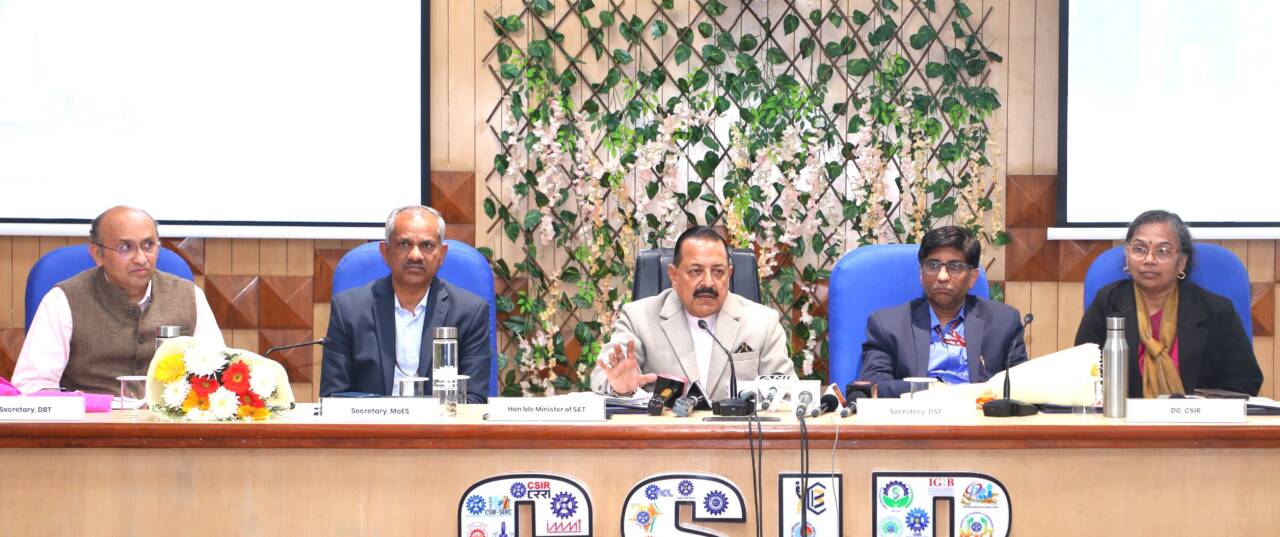
 Union Minister Dr Jitendra Singh today described the Union Budget 2026–27 as a forward-looking, technology-driven roadmap designed to transform India over the next 25 years. Speaking at a post-Budget briefing organized by the Ministry of Science & Technology, he emphasized that the Budget integrates cutting-edge AI into structural reforms, aiming to drive sustainable growth and inclusive development.
Highlighting benefits for the middle class, Dr Singh said the Budget prioritizes long-term relief from healthcare costs, targeting chronic diseases like cancer, diabetes, and metabolic disorders through large-scale investments in biopharma, diagnostics, vaccines, and gene-based therapies. He noted that India’s healthcare challenges are growing, with over 11–12 crore diabetics, nearly 14 crore pre-diabetics, and rising cancer cases projected to reach two million annually by 2030.
Under initiatives like Biopharma Shakti, with a ₹10,000 crore allocation, India is strengthening its position as a global bio-manufacturing hub, focusing on biologics, vaccines, medical devices, and gene-based technologies. Dr Singh termed biotechnology as the next industrial driver, comparable to IT in previous decades, and predicted a bio-revolution encompassing recycling, regeneration, and advanced life sciences.
The Budget also addresses mental health and traditional medicine, with new super-speciality mental health institutes and Ayurveda/pharmaceutical education centers being established. Other strategic moves include extended customs duty exemptions for nuclear power components, rare earth corridors, critical mineral initiatives, and the National Geospatial Mission, which will enhance urban planning, infrastructure, and land management.
Dr Singh further highlighted a ₹20,000 crore allocation for Carbon Capture, Utilisation, and Storage (CCUS) and the deployment of AI in agriculture to empower farmers while ensuring equitable technology adoption. The Budget includes inclusive measures benefiting the poorest sections through healthcare access, district-level cancer care, women-led entrepreneurship, and science-based livelihood initiatives.
Top officials from the Ministries of Science & Technology, Biotechnology, Earth Sciences, and CSIR underscored the Budget’s focus on mega R&D infrastructure, national telescopes, the Blue Economy, semiconductors, and clean energy, emphasizing the alignment of research, manufacturing, and deployment in a mission-oriented approach.
Dr Singh concluded that Budget 2026–27 sets India on a path to compete in technology-intensive global sectors while ensuring growth remains inclusive, sustainable, and citizen-centric.
जानकी जयंती पर विशेष : सीता महा पंडित रावण की बेटी थी – डॉ. कमल के.प्यासा
Sponsored

Nurturing Creativity – Keekli Charitable Trust, Shimla