
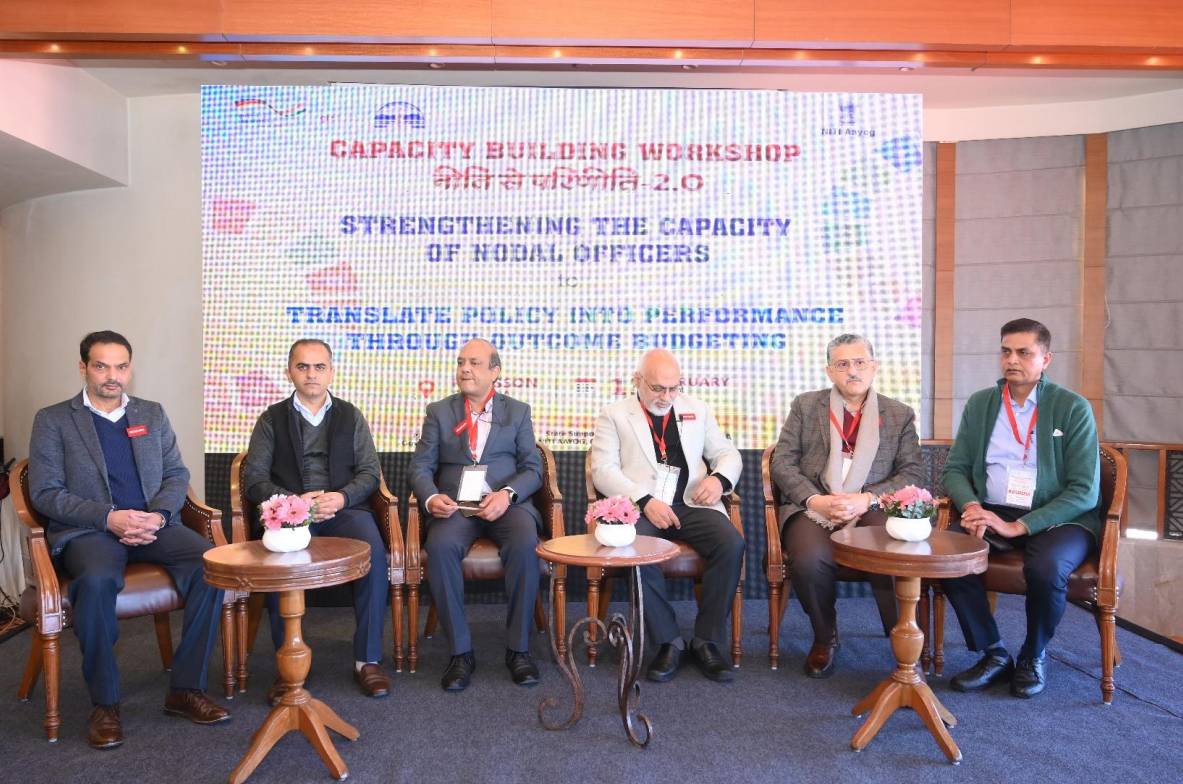
 A one-day Capacity Building Workshop on “Strengthening the Capacity of Nodal Officers to Translate Policy into Performance through Outcome Budgeting” was organized as part of the ongoing “नीति से परिणीति 2.0” series, aimed at reinforcing departmental planning systems and ensuring effective conversion of policies into measurable outcomes.
The workshop was conducted with the support of the State Transformation Cell under the State Support Mission of NITI Aayog, in collaboration with GIZ India as the technical partner.
Delivering the inaugural address, Advisor, Planning Department, Dr. Basu Sood emphasized that Outcome Budgeting represents a shift from traditional financial reporting to evidence-based governance, strategic planning, and measurable impact. He underlined the need to align departmental priorities with outcomes that tangibly improve citizens’ quality of life.
The workshop featured expert-led sessions introducing officers to national and international best practices in Outcome Budgeting, the Theory of Change framework, and the development of SMART indicators to track measurable progress. A dedicated session on “NITI for States” provided insights into the State Support Mission’s role in strengthening institutional capacity, promoting evidence-based policymaking, and aligning departmental outcomes with broader state development goals.
Discussions also focused on data-driven planning and budgeting, highlighting the importance of reliable data systems, monitoring frameworks, and informed decision-making. A practical session on SDG linkages helped participants understand how departmental schemes contribute to the State’s commitments toward global development goals. Officers were also briefed on the State Budgeting Process to better comprehend the linkage between budget allocations, outcomes, and performance measurement.
Participants actively engaged in discussions and hands-on exercises designed to enhance their ability to translate policy intent into measurable results. The workshop reinforced that Outcome Budgeting is not merely a financial exercise but a shift in mindset—from tracking expenditure to evaluating impact.
Departments were encouraged to consistently adopt these principles in planning and monitoring to ensure that public spending serves as a catalyst for development, strengthening transparency, accountability, and public trust.
Sponsored

Daily News Bulletin
Nurturing Creativity – Keekli Charitable Trust, Shimla