
 The Union Budget 2026–27 has unveiled a major policy initiative to position India as a global hub for digital infrastructure. Recognizing the strategic importance of cloud computing, AI data centres, and advanced electronics for economic growth, the government has proposed a tax holiday until 2047 for eligible foreign cloud service providers operating through India-based data centres.
Globally, data centres are emerging as key drivers of investment. According to the United Nations Conference on Trade and Development (UNCTAD), they accounted for over one-fifth of global greenfield project values in 2025, with announced investments exceeding USD 270 billion. Rapid growth in AI and data-intensive services is intensifying international competition to attract such infrastructure. India’s long-term tax framework aims to provide investment certainty, anchor high-value digital infrastructure locally, and strengthen its role in global digital value chains, in line with the vision of Viksit Bharat by 2047.
The policy addresses the high capital requirements, long gestation periods, and operational complexity of data centres, particularly AI-focused ones. By offering a tax holiday until 2047, the government seeks to attract global cloud providers while ensuring that critical digital infrastructure remains in India.
Under the proposed framework, foreign companies providing global cloud services through India-based data centres will be exempt from Indian taxation on such operations, provided certain conditions are met. Services to Indian customers must be routed through an Indian reseller, ensuring domestic transactions remain taxable. The exemption applies from Tax Year 2026–27 to 2046–47, providing long-term stability for investors.
Eligibility for the tax holiday requires notification under relevant provisions, use of Indian data centre services notified by the Ministry of Electronics and Information Technology (MeitY), and delivery of services to Indian users via an Indian reseller. This structured framework ensures regulatory oversight and alignment with policy objectives.
Domestic operations, including services provided by Indian data centres to foreign entities and resales to Indian customers, will remain taxable. A safe harbour margin of 15% has been proposed for related Indian data centre entities operating on a cost-plus basis. This approach provides clarity and reduces compliance uncertainty.
The tax holiday forms part of a broader Budget 2026–27 strategy to strengthen India’s technology and digital manufacturing ecosystem. Key initiatives include India Semiconductor Mission (ISM) 2.0, which focuses on semiconductor design, manufacturing, material production, and talent development, with an allocation of ₹1,000 crore in FY 2026–27. The Electronics Components Manufacturing Scheme (ECMS) allocation has been raised from ₹22,000 crore to ₹40,000 crore, reflecting strong industry participation.
For the IT services sector, the Budget proposes simplification by grouping software development, IT-enabled services, KPO, and contract R&D under a single category. A common safe harbour margin of 15.5% is introduced, the threshold for eligibility is increased from ₹300 crore to ₹2,000 crore, and the approval process will be automated. The Unilateral Advance Pricing Agreement (APA) process will also be fast-tracked.
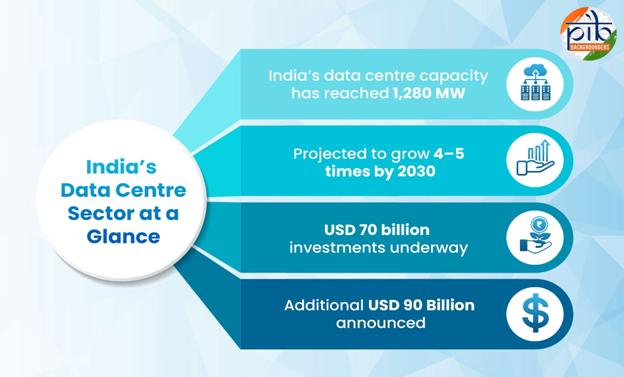
India’s cloud and data centre ecosystem continues to expand, supported by initiatives like the national cloud infrastructure GI Cloud (MeghRaj) under the Digital India program. Current data centre capacity is around 1,280 MW, projected to grow four to five times by 2030. Investments in AI-focused data centres already total nearly USD 70 billion, with another USD 90 billion announced. The extended tax framework provides long-term visibility for such capital-intensive projects.
Globally, AI and cloud infrastructure is being prioritized through supportive policies. In the United States, a Presidential Executive Order expedites regulatory approval and development of large AI data centres, while Chinese cloud and AI providers are rapidly expanding infrastructure domestically and abroad. These developments highlight the strategic importance of AI and cloud data centres, reinforcing the relevance of India’s long-term tax framework.
In conclusion, the tax holiday and associated measures under Budget 2026–27 offer long-term certainty for global cloud and AI infrastructure investment in India. Coupled with semiconductor, electronics, and IT sector initiatives, the framework positions India as a competitive, credible, and long-term destination for digital and AI infrastructure investment in a highly competitive global landscape.


Nurturing Creativity – Keekli Charitable Trust, Shimla