
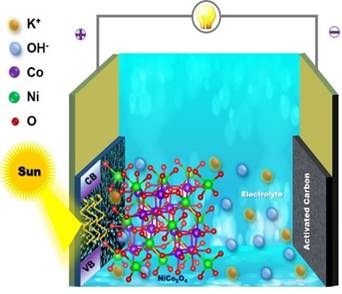
 Indian researchers have developed a groundbreaking sunlight-powered supercapacitor, called a photo-capacitor, capable of both harvesting and storing solar energy in a single device. This innovation promises a new era of efficient, low-cost, and eco-friendly energy solutions for portable, wearable, and off-grid technologies.
Traditionally, solar energy systems use separate units for energy capture and storage, requiring extra electronics to manage voltage and current mismatches. This increases complexity, cost, and energy losses, especially in miniaturized or autonomous devices.
The new device, developed by the Centre for Nano and Soft Matter Sciences (CeNS), Bengaluru under the Department of Science and Technology (DST), integrates solar energy harvesting and storage, minimizing energy loss and simplifying design. Under the guidance of Dr. Kavita Pandey, the team used binder-free nickel-cobalt oxide (NiCo₂O₄) nanowires grown on nickel foam through a simple hydrothermal process.
The nanowires, only a few nanometers wide and several micrometers long, form a porous 3D network that efficiently absorbs sunlight and stores charge. Tests showed a 54% increase in capacitance under light, rising from 570 to 880 mF cm⁻², and retained 85% of capacity even after 10,000 cycles, demonstrating exceptional stability.
For practical applications, researchers built an asymmetric photo-supercapacitor using NiCo₂O₄ as the positive electrode and activated carbon as the negative electrode. The device produced a stable 1.2-volt output, maintained 88% capacitance after 1,000 photo-charging cycles, and worked efficiently under varying sunlight conditions, from low indoor light to intense solar exposure.
This innovation could power devices in remote areas without grid access, reducing reliance on fossil fuels and conventional batteries. Theoretical studies revealed that nickel substitution in the cobalt oxide framework narrows the band gap to 1.67 eV and induces half-metallic behavior, enabling faster charge transport and higher conductivity — key for light-assisted energy storage.
Published in Sustainable Energy & Fuels, the study represents a major step in integrating solar harvesting and storage in a single smart device, potentially revolutionizing renewable energy technology and supporting India’s clean energy goals.


Nurturing Creativity – Keekli Charitable Trust, Shimla