
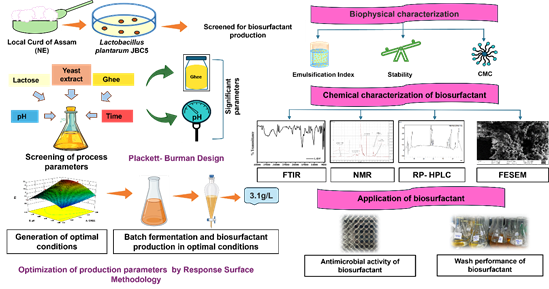
 A Department of Science and Technology (DST)-affiliated institute in North East India has successfully synthesised a novel biosurfactant with antibacterial and cleansing properties using natural substances. The compound shows potential for use in cosmetics and medicines, offering a sustainable alternative to artificial surfactants.
The biosurfactant has proven effective against Staphylococcus aureus, a bacterium responsible for skin and wound infections, and enhances stain removal when blended with commercial face washes. Surfactants are widely used as lubricants, dispersants, and emulsifiers across industries, but growing concerns over the toxicity and non-biodegradability of synthetic surfactants have created demand for bio-based alternatives.
The study, led by Prof. Ashis K. Mukherjee, Director of IASST, along with Prof. M.R. Khan and Anushree Roy, used the probiotic Lactobacillus plantarum JBC5 and ghee as a lipid-rich substrate to synthesise the biosurfactant. The team employed response surface statistical analysis to optimise production. The resulting lipopeptide biosurfactant achieved a 60% emulsification index for edible oils, demonstrated surface tension-reducing properties comparable to conventional surfactants, and maintained exceptional stability at temperatures up to 276°C across varied pH levels.
The compound’s antibacterial efficiency against Staphylococcus aureus and its enhanced cleansing performance highlight its potential to substitute harmful synthetic surfactants in personal care products. The researchers are now conducting toxicity assessments, dose standardization, and industry collaborations to accelerate commercialization of this biobased surfactant.


Nurturing Creativity – Keekli Charitable Trust, Shimla