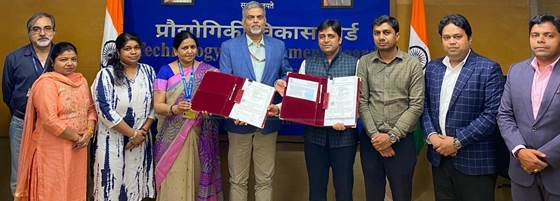
The Technology Development Board (TDB) has entered into an agreement with M/s Remine India Private Limited, for “Setting up a commercial plant for recycling of Li Battery and E-Waste using Indigenous Technology” at Eldeco, SIIDCUL Industrial Area in Sitarganj (District Udham Singh Nagar), Uttarakhand on 27th March 2024 in New Delhi.
Through the agreement, TDB has pledged a financial assistance of ₹ 7.5 crores out of the total project cost of ₹ 15 crores, marking a significant stride towards sustainable development and environmental stewardship.
The funded project entails the establishment of a commercial plant for the recycling of Li-ion batteries and e-waste, leveraging indigenous technology developed by the Centre for Materials for Electronics Technology (CMET), Hyderabad. Recognized as a matter of national significance, the efficient recycling of Li-ion batteries serves as a vital source of secondary raw materials for cell manufacturing within the country.
The escalating imports of e-waste stemming from the disposal of spent Lithium-ion Batteries (LIBs) are driven by their growing utilization in portable electronics, electric vehicles, and global renewable energy storage systems. However, the disposal of LIBs through landfilling and incineration poses environmental and safety concerns, highlighting the need for recycling initiatives. The potential for value creation through the retrieval of metals from spent LIBs has spurred interest in recycling e-waste generated by these batteries.
The lithium-ion battery recycling market size is projected to reach USD 14.89 billion by 2030, with a Compound Annual Growth Rate (CAGR) of 21.6%, up from USD 3.79 billion in 2021. Despite this, a significant 95% of Li-ion batteries currently end up in landfills, while only 5% undergo recycling and reuse.
TDB Signs Agreement With Remine India
The dominance of the informal sector in the e-waste scenario has adverse environmental and economic implications. Efficient and environmentally friendly recycling methods are imperative to address the escalating issue of battery waste, mitigate migrant supply side risks related to critical elements, and reduce carbon footprints.
Speaking on the occasion, Rajesh Kumar Pathak, Secretary, TDB, said, “India is 3rd in the world in terms of e-waste generation and significant efforts are required to curb the issue. TDB supporting this initiative would help to engage informal recyclers to connect with formal recyclers thereby contributing towards circular economy.”
Li-ion Batteries And E-Waste In Uttarakhand
Sponsored

Nurturing Creativity – Keekli Charitable Trust, Shimla