
 Astronomers have solved the mystery behind the intriguing flickering observed in black hole systems, using advanced computer simulations. These flickers, known as quasi-periodic oscillations (QPOs), are variations in high-energy radiation emitted by matter swirling into black holes.
Black holes, the densest objects in the universe, are studied indirectly by observing the radiation from the surrounding accretion disc, a temporary structure formed as matter spirals inward. The type of radiation emitted depends on the motion of matter in the disc: when rotational motion dominates, thermal radiation is produced, but when matter falls inward rapidly, non-thermal radiation with rhythmic oscillations occurs.
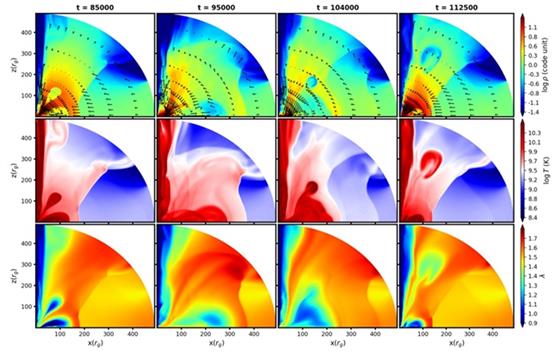
Researchers from the Aryabhatta Research Institute of Observational Sciences (ARIES), in collaboration with scientists from India, Poland, and France, used a numerical simulation code that conserves energy, mass, and momentum to study how viscous accretion flows behave near black holes. They discovered that inflowing gas does not always fall smoothly; instead, it forms shocks, sudden transitions where the flow slows, heats, and densifies, similar to shock waves in supersonic jets.
When the disc has sufficient viscosity and radiative cooling, these shocks become unstable, wobble, and oscillate. These oscillations naturally generate the observed QPOs. The simulations also revealed that shocks can produce bipolar jets perpendicular to the disc. In regions of higher viscosity, bubble-like turbulent zones form and erupt, with outflows reaching speeds exceeding 25% the speed of light.
This study, published in The Astrophysical Journal (ApJ), is likely the first 2D simulation of viscous, transonic accretion flows onto black holes using a relativistic equation of state for electron-proton plasma. The results show that low-frequency QPOs in stellar-mass black holes, ranging from below 1 Hz to tens of Hz, can be fully explained by these oscillating shocks in the accretion disc.


Nurturing Creativity – Keekli Charitable Trust, Shimla