
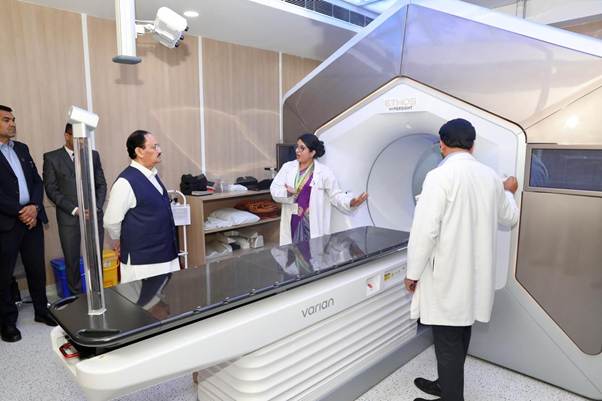
 In a significant move to enhance technology-driven critical care, Union Health Minister J.P. Nadda inaugurated the AI-Enabled E-ICU Command Centre at Yashoda Medicity in Ghaziabad. The new facility integrates artificial intelligence with centralized monitoring systems to improve clinical outcomes and streamline intensive care management. During the event, Nadda commended Yashoda Medicity for its high-quality healthcare services across 65 specialties and highlighted its collaboration with MMG District Hospital as a demonstration of corporate social responsibility and public health strengthening.
The Minister emphasized that AI-enabled healthcare enables timely intervention, diagnostic precision, and real-time patient monitoring, which are crucial in emergency and intensive care settings. He noted that AI-supported ICUs can provide early warnings in critical situations, help identify high-risk cases, and support clinicians with data-driven insights, thereby improving decision-making and patient safety. The inauguration of this Command Centre is expected to further strengthen critical care services at the district level and enhance patient outcomes.
Nadda outlined the broader national vision under Prime Minister Narendra Modi, stressing the government’s commitment to integrating digital technologies and AI in healthcare. He recalled that the National Health Policy, 2017, laid the groundwork for a comprehensive digital health ecosystem aligned with the Digital India initiative, aiming to transform healthcare delivery through technology. Highlighting the progress of Ayushman Bharat, he stated that over 1.81 lakh Ayushman Arogya Mandirs are operational nationwide, with more than 50,000 already certified under the National Quality Assurance Standards (NQAS). The government has set a target to achieve 100% NQAS certification for all centers within the next two years, ensuring high-quality primary healthcare across the country.
The Health Minister also highlighted key digital initiatives, including the eSanjeevani telemedicine platform, which has provided teleconsultations to over 45.2 crore people, enhancing access to specialist healthcare, particularly in remote areas. The U-WIN digital platform has registered over 11.47 crore pregnant women to track maternal and child health services, supporting timely antenatal care, immunizations, and the Universal Immunization Programme that covers 27 vaccine doses against 12 diseases, achieving nearly 99% immunization coverage.
Nadda further noted the role of AI in disease control, citing AI-enabled handheld X-ray devices that have strengthened tuberculosis screening. India’s TB incidence decline rate of 17% surpasses the global average of 7%. He also pointed to improvements in maternal and child health indicators, attributing these gains to digital tracking and targeted interventions. The Minister highlighted the launch of the SAHI portal and BODH initiative to promote ethical, validated, and standardized use of AI in healthcare.
Highlighting India’s public health achievements, Nadda praised the country’s global leadership in vaccination and affordable pharmaceuticals. He recalled India’s development of two indigenous COVID-19 vaccines within nine months and administration of over 220 crore doses, supported by a fully digital certification system. On Ayushman Bharat – Pradhan Mantri Jan Arogya Yojana, he noted that the scheme covers around 62 crore beneficiaries, including all senior citizens above 70, with health coverage of ₹5 lakh per family annually. According to a Lancet study, the scheme has facilitated initiation of cancer treatment within 90 days of detection, underscoring its impact on timely intervention and reducing treatment delays.
The AI-Enabled E-ICU Command Centre at Yashoda Medicity connects the base centre with the ICU facility at MMG District Hospital. By integrating hospital information systems and bedside devices into a centralized dashboard, the system enables AI-driven risk stratification, early alerts for clinical deterioration, and evidence-based interventions through continuous specialist oversight. This model enhances clinical coordination, standardizes treatment protocols, and supports on-ground medical teams, extending specialist supervision to underserved regions and improving access to quality intensive care.
Senior officials from the Ministry of Health and Family Welfare, representatives of Yashoda Medicity, medical professionals, and other dignitaries attended the inauguration.
Sponsored

Nurturing Creativity – Keekli Charitable Trust, Shimla