
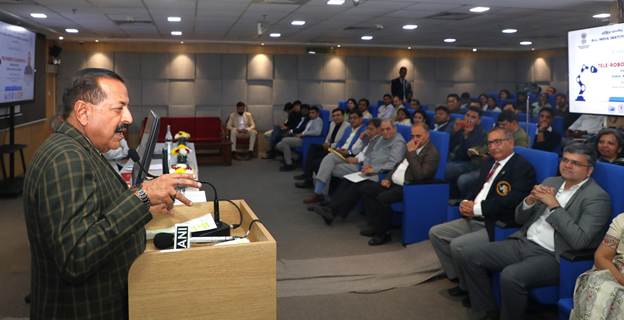
 India showcased a milestone in AI-enabled healthcare today as Dr. Jitendra Singh, Union Minister of State (Independent Charge) for Science & Technology and Earth Sciences, witnessed a live demonstration of an indigenously developed Tele-Robotic Ultrasonography (TUS) system. The system enabled radiologists at AIIMS, New Delhi to conduct real-time ultrasound examinations of a volunteer stationed over 12,000 km away at Maitri Research Station, Antarctica.
The system, developed jointly by AIIMS New Delhi, IIT Delhi, and the National Centre for Polar and Ocean Research, integrates robotics, AI, and medical expertise. Its robotic arm replicates a sonographer’s hand movements with six degrees of freedom, providing diagnostically reliable imaging with less than one-second delay. It supports critical assessments such as trauma screening, cardiac evaluation, and abdominal scans—enabling informed decisions about local treatment versus evacuation in extreme environments.
Dr. Jitendra Singh highlighted the initiative as an example of India’s “whole-of-science” and “whole-of-government” approach, bringing together multiple institutions to deliver high-impact solutions. He emphasized that innovations like this not only support India’s polar expeditions but also have the potential to transform healthcare in remote villages, disaster zones, border areas, and mobile medical units.
Dr. M. Ravichandran, Secretary, Ministry of Earth Sciences, added that the technology could reduce emergency evacuations and strengthen India’s collaborative scientific presence in polar regions.
Dr. Singh concluded that such innovations demonstrate how India is expanding healthcare access through cutting-edge science and integrated governance, ensuring high-quality medical care from the poles to the remotest corners of the country.


Nurturing Creativity – Keekli Charitable Trust, Shimla