
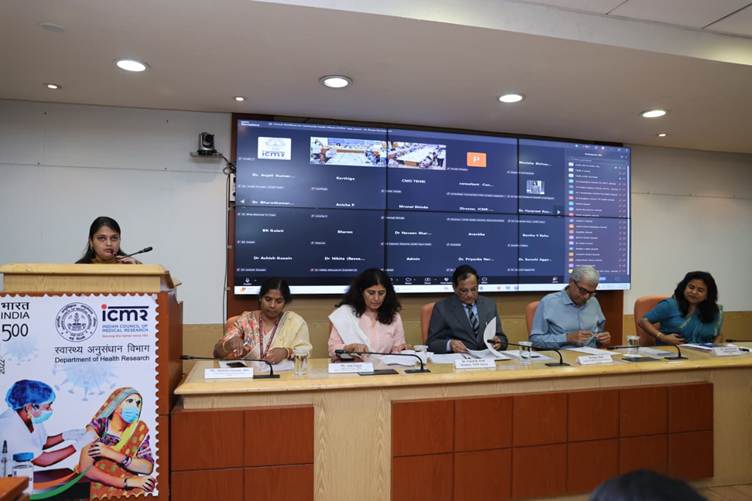
 The Ministry of Health and Family Welfare on Monday introduced a new mobile application aimed at strengthening the clinical workflow of Community Health Officers (CHOs) and enhancing primary healthcare delivery across India.
Developed by the Indian Council of Medical Research (ICMR), the application serves as a clinical decision-support tool and job aid for CHOs working at Sub-Centre Ayushman Arogya Mandirs (SC-AAMs). It is aligned with the 12 service packages under Comprehensive Primary Health Care (CPHC), ensuring a standardized approach to patient care.
The app offers structured clinical workflows designed as quick-reference guides for outpatient management. It provides step-by-step support for patient assessment, including history-taking, physical examination, and diagnostic evaluation based on symptoms. It also enables CHOs to identify cases requiring urgent referral and guides pre-referral care to stabilize patients.
For non-emergency cases, the platform supports informed decision-making by recommending appropriate treatment at SC-AAMs, referral pathways, or teleconsultation with higher-level facilities. A color-coded system—ranging from red for critical cases to green for mild conditions—simplifies clinical judgments.
In addition, the application integrates features such as patient registration, electronic health records, diagnostic reporting, teleconsultation, and follow-up tracking. It is designed to work seamlessly with existing national digital health platforms to ensure continuity of care.
Speaking at the launch, Dr. V. K. Paul, Member (Health), NITI Aayog, highlighted the importance of primary healthcare as the backbone of India’s health system and a key driver toward universal health coverage. He noted that the app’s rollout coincides with eight years of the Ayushman Arogya Mandir initiative and emphasized the need for continuous improvements, including the integration of artificial intelligence.
Dr. Rajiv Bahl, Director General of ICMR and Secretary, Department of Health Research, described the launch as a significant step toward strengthening digital clinical support at the primary care level. He added that the application will evolve based on field usage and feedback from healthcare workers.
The government expects the new digital tool to improve the quality, consistency, and timeliness of care at the grassroots level while empowering frontline health workers with standardized clinical protocols.


Daily News Bulletin
Nurturing Creativity – Keekli Charitable Trust, Shimla