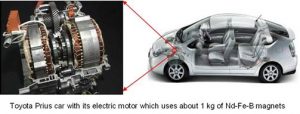
 PIB Delhi – Scientists have fabricated improved low cost heavy rare earth-free high Nd-Fe-B magnets, which are in high demand for Electric Vehicles and can make them more affordable. More than 90% of EVs use brushless DC (BLDC) motors made up of rare earth Neodymium Iron Boron (Nd-Fe-B) magnets. Since its discovery by Sagawa in 1984, the Nd-Fe-B magnet has been one of the most sought-after permanent magnetic materials for many applications due to its exceptional combination of magnetic properties.
Nd-Fe-B magnets used in EVs operate at high temperatures of 150 – 200oC and need to exhibit high resistance to demagnetization, a capability that pure Nd-Fe-B magnets do not have. Hence Dysprosium (Dy) metal is added as an alloy to improve the resistance to demagnetization. World over, researchers are trying to enhance coercivity (resistance to demagnetisation) of Nd-Fe-B magnets without the addition of costly Dy. A strategy adopted by the research community to enhance coercivity is to enrich the region between the grains of the Nd-Fe-B magnet with “non-magnetic” elements through suitable heat treatments (grain boundary diffusion). Recently, scientists from the Centre for Automotive Energy Materials at the International Advanced Research Centre for Powder Metallurgy & New Materials (ARCI), an autonomous Research and Development Centre of the Department of Science and Technology (DST), Govt. of India, have enhanced the coercivity of Niobium (Nb)-containing Nd-Fe-B melt-spun ribbon by grain boundary diffusion process (GBDP) using a low melting point alloy of Nd70Cu30 which acts as the source for the “non-magnetic” element.
They have reported restricted grain growth during grain boundary diffusion due to the precipitation of Nb, which facilitates the enrichment of Copper (Cu) at the grain boundaries aiding the increased resistance to demagnetization of Nd-Fe-B powders. The coercivity value of 1 T at 150oC critical for automotive applications achieved in this research published in Materials Research Letter could be a useful strategy to develop magnets without Dy for EV applications. ARCI has ventured into setting up of pilot plant for manufacturing of near net shaped Nd-Fe-B magnets through a major project funded by the Science and Engineering Research Board (SERB) in line with the Atmanirbhar Bharat mission of the Government of India, and the above strategy will be explored for the magnets manufactured in the pilot plant. The new strategy could also be used for commercial production of Nd-Fe-B magnets in India, reducing imports that meet the major requirements of the automotive sector.


Nurturing Creativity – Keekli Charitable Trust, Shimla