
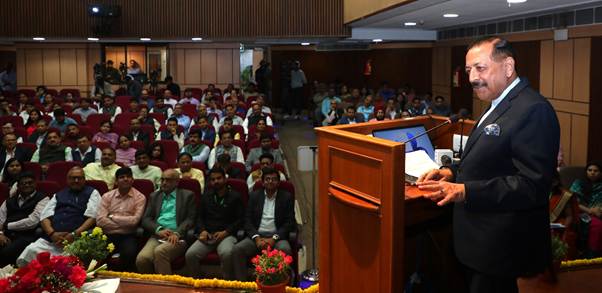
 Union Minister Jitendra Singh said that women in science are powerful catalysts in India’s journey toward Viksit Bharat, addressing the National Science Day Celebration–2026 at the INSA Auditorium in New Delhi. Emphasizing the theme “Women in Science: Catalyzing Viksit Bharat,” he underlined that inclusive participation—especially of women—is essential to sustaining India’s innovation momentum and linking scientific growth with national development.
The Minister highlighted the increasing representation of women in research and leadership roles, noting that India’s science ecosystem must nurture talent across gender and geography. He stressed the need for sustained institutional support, early-stage mentoring, and translational pathways to ensure that research delivers tangible societal impact. Empowering young students—particularly girls—through structured exposure to laboratories and research institutions, he said, would create a long-term multiplier effect.
Several major initiatives were launched during the event, including the Hydrogen Valley Innovation Cluster and the ANRF–Venture Centre Outreach Initiative. The Mission Innovation India Report and the book Indigenous Architecture of Northeast India were also released. In a significant technology transfer, a DST-supported copper-doped nano titania coating for heritage stone conservation was handed over to M/s Rebuild Technologies Services Pvt. Ltd., marking progress in translating laboratory research into real-world applications.
The advanced Cu–TiO₂ coating technology enhances hydrophobicity, UV resistance, and aesthetic compatibility for marble, sandstone, and granite, offering durable protection for heritage monuments. Additionally, the “Engage with Science” programme, conceptualized by the National Council for Science & Technology Communication (NCSTC), was launched to provide immersive exposure to students of Classes 8 and 9 across 16 DST institutions, nurturing early interest in research.
Secretary, DST, Abhay Karandikar, and Secretary, DBT, Rajesh Gokhale, highlighted the importance of strengthening innovation clusters, translational research, and interdisciplinary collaboration aligned with national priorities.
Concluding the event, Dr. Jitendra Singh reiterated that India’s scientific advancement must be measured not merely by global rankings but by its ability to deliver solutions for its people. He affirmed that empowering women scientists, fostering indigenous innovation, conserving heritage through science, and nurturing young talent are central to realizing the vision of Viksit Bharat.


Nurturing Creativity – Keekli Charitable Trust, Shimla