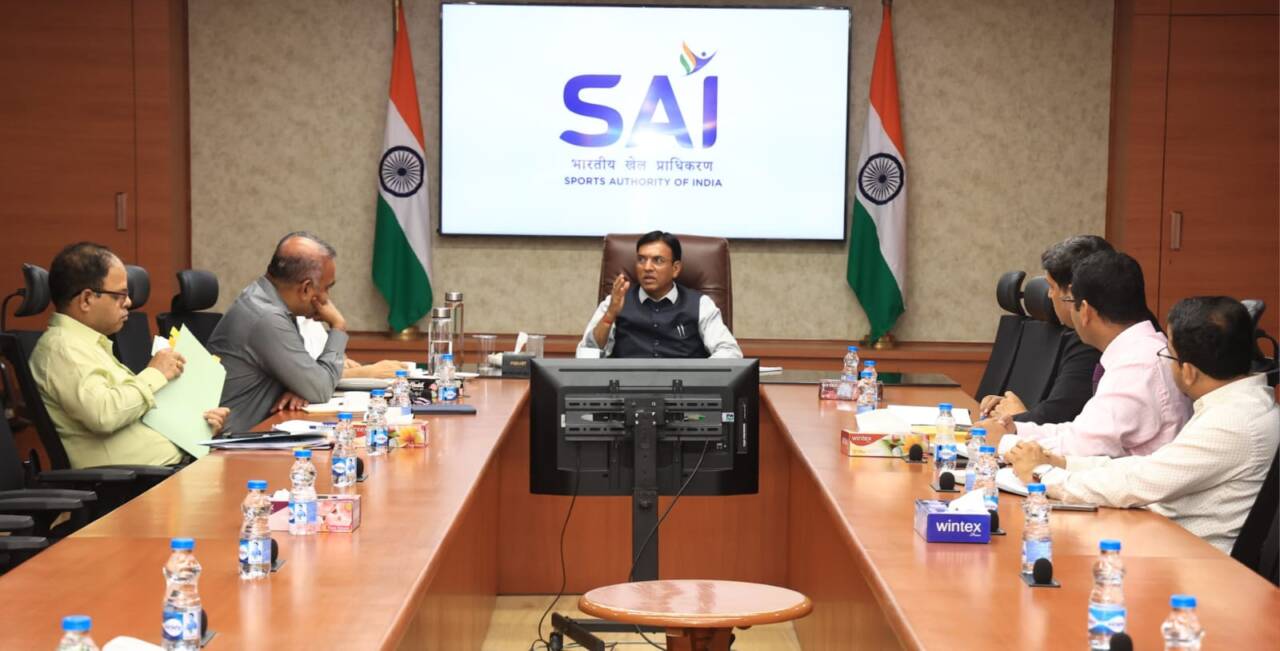
 Union Minister for Youth Affairs and Sports, Dr. Mansukh Mandaviya, chaired a high-level meeting at the Sports Authority of India (SAI) headquarters on Thursday to review India’s preparations for the 2026 Asian Games, scheduled in Aichi-Nagoya, Japan, from September 19 to October 4. Senior officials from the Ministry of Youth Affairs and Sports, SAI, and other stakeholders briefed the minister on the country’s readiness, ensuring that athletes receive full support to excel at the continental event.
A 15-member committee formed to oversee the Asian Games preparations includes Hari Ranjan Rao, Secretary, Ministry of Youth Affairs & Sports, PT Usha, President of the Indian Olympic Association, Sahdev Yadav, Asian Games Chef de Mission, and Sharath Kamal, Deputy Chef de Mission. The committee has already held four meetings since December 2025 to streamline planning across training, logistics, athlete welfare, and competition readiness, charting a strategic roadmap for India’s campaign.
During the meeting, Dr. Mandaviya reaffirmed the government’s commitment to athlete welfare and performance. “Our athletes are our top priority. Every possible support, from training and sports science to logistics, kit supply, food, and medical care, will be provided so they can focus on delivering their best at the Asian Games. Our goal is to ensure they remain distraction-free and increase India’s medal tally,” he said.
The minister also emphasised the importance of coordinated efforts among all stakeholders. Structured preparation, strong support systems, and timely planning are crucial to help India achieve new milestones at the Games.
As part of preparations, Nodal Officers have been designated for the Asian Games Technical Handbook by each National Sports Federation (NSF) to educate players, coaches, and support staff on discipline-wise technical requirements. Teams will be finalised well in advance, with additional support staff, including medical teams, deployed across multiple locations to provide seamless assistance. Federations have also been given the freedom to plan exposure tours and competition schedules, while acclimatisation measures, including simulating competition conditions in India, are being implemented.
India aims to surpass the historic 106-medal haul achieved at the Hangzhou Asian Games 2022. Over 700 Indian athletes are expected to compete across 40+ sports disciplines at the 2026 Games.
The meeting highlighted that the Aichi-Nagoya Asian Games will follow a five-cluster competition model, with events spread across Aichi, Gifu, Shizuoka, and the Airport-Expo zone. This model requires detailed planning for travel, logistics, medical support, and athlete recovery. To help athletes adjust, makeshift container-style accommodations will be set up at SAI regional centres in Patiala and Bengaluru, allowing athletes to familiarise themselves with living conditions expected at the Games.
The committee also reviewed a four-day recce visit by an IOA delegation in January, which inspected key venues, athlete facilities, and logistics infrastructure in Japan. Based on the findings, cluster-wise planning is being implemented with dedicated logistics officers, medical teams, and support staff to ensure smooth operations for Indian athletes.
Athlete-focused measures discussed include appointing a head medical doctor for the contingent, finalising Indian food options with SAI culinary staff, ensuring timely distribution of official kits, conducting discipline-wise performance reviews, early team finalisation, and strengthening support staff, including medical and recovery teams.
The next preparatory committee meeting is scheduled for March 20, where final discussions on contingent size, logistics, travel arrangements, and operational readiness will be held, marking the decisive phase of India’s preparations for the continental sporting spectacle.
Nurturing Creativity – Keekli Charitable Trust, Shimla