
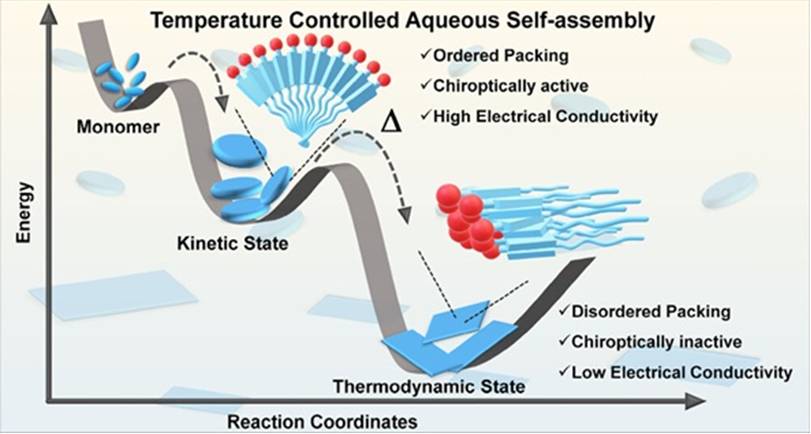
 Researchers have achieved a major breakthrough in guiding small organic molecules to form advanced, functional nanomaterials, opening pathways for future electronic devices, tunable optoelectronics, responsive materials, and bioelectronic interfaces.
The study, conducted by the Centre for Nano and Soft Matter Sciences (CeNS), Bengaluru, in collaboration with the Jawaharlal Nehru Centre for Advanced Scientific Research (JNCASR)—both under the Department of Science and Technology (DST), Government of India—focused on naphthalene diimide (NDI), an amphiphilic molecule capable of organizing itself in water via supramolecular self-assembly.
At room temperature, NDI molecules assemble into circular nanodisks with unique optical properties that interact with polarized light (chiroptical activity). When heated, the nanodisks reorganize into two-dimensional nanosheets, losing their chiroptical activity and showing a sevenfold decrease in electrical conductivity. This demonstrates that temperature can dynamically switch the structural, optical, and electrical properties of the material.
The ability to precisely tune nanoscale assemblies offers a promising route to smart, adaptive materials for electronics, sensors, photonics, and biomedical devices. The findings, published in ACS Applied Nano Materials, highlight how supramolecular chemistry can engineer highly tunable, efficient materials for next-generation technologies.
The research was led by Dr. Goutam Ghosh (CeNS), with contributions from PhD student Sourav Moyra (CeNS) and Tarak Nath Das (JNCASR), providing critical insights into designing temperature-responsive nanomaterials for advanced applications.
Sponsored

Nurturing Creativity – Keekli Charitable Trust, Shimla