
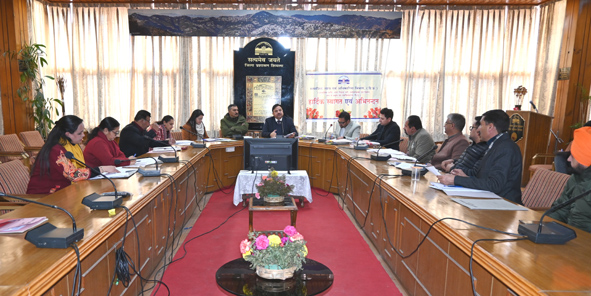
 With the objective of ensuring inclusive and balanced development across all sections of society, a series of district-level review meetings were held under the chairmanship of Deputy Commissioner Anupam Kashyap. The meetings focused on social justice, minority welfare, sanitation workers’ welfare, and empowerment of persons with disabilities.
Review of SC/ST (Prevention of Atrocities) Act Cases
A district-level Vigilance and Monitoring Committee meeting was convened by the Social Justice and Empowerment Department under the Scheduled Castes/Scheduled Tribes (Prevention of Atrocities) Act, 1989. It was informed that 40 cases registered under the Act since 2018 are currently pending in courts.
Deputy Commissioner Anupam Kashyap stated that providing social security is a top priority for the administration. He emphasized the need for practical efforts to bring equality in society. Noting the high rate of acquittals in SC/ST cases, he said the administration would study these cases to identify underlying causes and formulate new strategies to strengthen future cases.
He also announced that special workshops would be organized for all investigating officers of the district police to improve case processing and investigation quality, as many cases registered by the police fail to stand in court.
The meeting was attended by Senior Superintendent of Police Sanjeev Kumar Gandhi, Additional District Magistrate (Law & Order) Pankaj Sharma, District Welfare Officer Kapil Sharma, and other officials.
Minority Welfare and Education Initiatives
Subsequently, a meeting of the District-Level Committee constituted under the Prime Minister’s New 15-Point Programme was held. The Deputy Commissioner informed that out of 2,154 Anganwadi centres in Shimla district, 231 are located in minority-populated areas. A total of 491 minority children aged 0–6 years are registered, of whom 387 are receiving supplementary nutrition and 137 children aged 3–6 years are enrolled in pre-school education.
Health assessments showed that most children are healthy, with only a small number identified as moderately or severely undernourished. Additionally, 102 pregnant and lactating women from minority communities are benefiting from welfare schemes.
Under the Samagra Shiksha programme, facilities such as Kasturba Gandhi Balika Vidyalayas are providing residential education to girls from SC, ST, minority, and economically weaker sections. Urdu education, mid-day meals, free textbooks, and uniforms are being provided to minority students in various schools. A madrasa operating in Kuthar village, Chaupal tehsil, is also imparting both formal and religious education.
Further, minority students are pursuing higher and technical education in government engineering, pharmacy, and polytechnic colleges, as well as Industrial Training Institutes. Financial assistance has been extended under term loan, education loan, MGNREGA, and Pradhan Mantri Awas Yojana schemes.
No Manual Scavenging in the District
A district-level meeting under the Prohibition of Employment as Manual Scavengers and their Rehabilitation Act, 2013, confirmed that no sanitation worker is engaged in manual scavenging in the district. Awareness camps have been organized, safety gear is being provided, and regular health check-ups are conducted for sanitation workers and their families.
Scholarships are being provided to children of sanitation workers, housing facilities have been extended to regular workers, and compassionate appointments are made as per state policy. The administration is also monitoring past incidents and ensuring due compensation to affected families through concerned agencies.
Employment and Support for Persons with Disabilities
Under the Rights of Persons with Disabilities Act, 2016, it was reported that 101 persons with disabilities were provided employment under MGNREGA during 2025–26. Eligible persons with disabilities are receiving monthly pensions based on the degree of disability, and over 7,000 beneficiaries are currently covered under social security pension schemes.
Under the Accessible India Campaign, 50 percent of government buildings at the district headquarters are targeted to be made barrier-free. Issuance of UDID cards and scholarships for students with disabilities is also underway.
Appointment of Legal Guardians
In another meeting held under the National Trust Act, 1999, it was informed that legal guardians have been appointed for 127 persons with disabilities in the district. Formalities for appointing legal guardians in two new cases have also been completed.
The Deputy Commissioner reiterated that the administration remains committed to ensuring equal development, social justice, and empowerment of all sections of society through effective implementation of welfare schemes.


Nurturing Creativity – Keekli Charitable Trust, Shimla