
Researcher have developed fresh insights into proton adsorption behaviour at the surface of catalysts, which can help construct electrocatalysts useful for producing green hydrogen. Plethora of heterostructures have been studied for green hydrogen generation with the effect of built-in electric field (BIEF). However, the metal-oxide-semiconductor (MOS) based p-n heterojunction considered as a promising material to have robust BIEF due to asymmetric electronic environment.
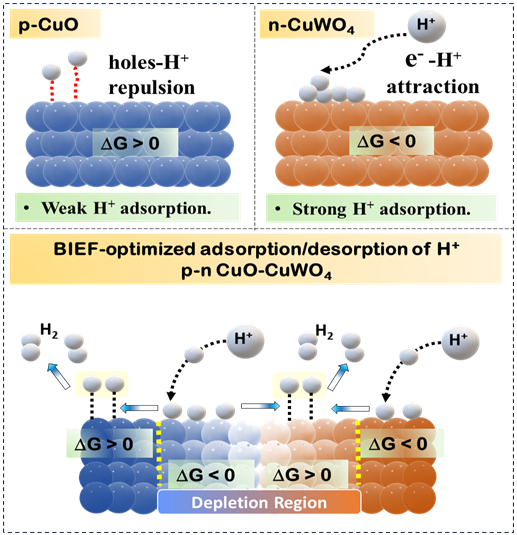
Recent research is focused on leveraging BIEFs at the interface of different electronic environments improve hydrogen production. Therefore, analysing and correlating parameters such as the work function, BIEF, and Gibbs free energy (a thermodynamic potential that can be used to calculate the maximum amount of work) is crucial for understanding the reaction mechanism.
The difference in work functions between two materials is what drives the initial charge redistribution, which in turn sets up the built-in potential across the junction. BIEF directly affects the dynamics of proton adsorption, desorption, which evaluated by Gibbs free energy of adsorption.

Scientists of Institute of Nano Science and Technology (INST), Mohali, grew CuWO4 (Copper tungsten oxide) nano-particles precursor over Cu (OH)2 (Copper hydroxide) and fabricated CuWO4-CuO hetero-structure and studied its physical and electrochemical properties.
They examined the Gibbs free energy profile for proton adsorption of different regiones and found that near the depletion region and along the interface, the proton adsorption energy shows contrasting behaviour as compared with bulk area. This induces a gradient in Gibbs free energy across and near the depletion region, thereby promoting an improved hydrogen adsorption and desorption.
Interestingly, Scientists from INST, an autonomous institute of the Department of Science and Technology (DST), demonstrated that the interplay between the built-in electric field (BIEF) and Gibbs free energy in the proposed catalyst gives rise to a favourable regime, where hydrogen bonding to the catalyst is optimized, facilitating efficient hydrogen evolution. They also found that along the heterojunction interface, the ∆G indicates high adsorption affinity of protons toward the CuO phase and significant desorption at the CuWO4 phase.
The CuO-CuWO₄ catalyst unveils an excellent example of negative cooperativity, in which the binding of one molecule decreases the affinity of other binding sites for additional molecules. With more and more proton coverage, the affinity of the catalyst’s surface towards the proton adsorption decreases, and promotes alkaline Hydrogen Evolution Reaction by enhancing desorption.
This research published in Adv. Energy Matter. 2025 helped understand the typical proton adsorption behaviour at the surface of the catalyst, which can help others to design and construct similar electrocatalyst which can give robust activity to produce green hydrogen. Improving in electrocatalytic hydrogen production can lead to sustainable environment with advance green technologies.
Sponsored

Nurturing Creativity – Keekli Charitable Trust, Shimla