
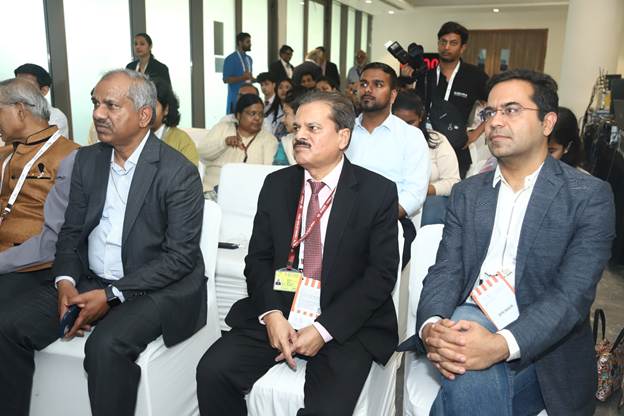
 Dr. M. Ravichandran, Secretary of the Ministry of Earth Sciences (MoES), today emphasized the need for a paradigm shift in meteorology, highlighting the integration of Artificial Intelligence (AI) with traditional physics-based models. This approach, he noted, is essential to address the growing unpredictability of climate extremes.
Speaking at the high-level panel discussion, “Harnessing AI to Manage Climate Extremes and Build Sustainable Systems”, on the final day of the India AI Impact Summit 2026 at Bharat Mandapam, Dr. Ravichandran explained that while conventional models are effective at broad spatial forecasts, AI plays a crucial role in capturing time-sensitive and localized weather patterns.
“The Elephant and the Ant” Analogy
Dr. Ravichandran used a vivid metaphor to illustrate the evolving challenge in weather prediction:
“Earlier, we tracked the ‘elephant’—large-scale weather systems. Today, due to climate change, we must also track the ‘ant’ on that elephant—hyper-local, time-sensitive variations.”
He stressed that combining physics-based models with AI could improve predictions for high-impact events like cloudbursts, which are notoriously difficult to forecast using traditional methods alone.
Key Takeaways from the Address
-
Reducing Model Assumptions: AI can help minimize errors inherent in numerical models, improving “initial conditions” and overall forecast accuracy.
-
Unlocking 150 Years of Legacy Data: Dr. Ravichandran urged that the India Meteorological Department (IMD) data be opened up to young researchers and multi-disciplinary experts for innovative research.
-
Power of Downscaling: AI can refine large-scale models to a 1-kilometer resolution, enabling precise local forecasting.
-
Building Trust through Validation: Rigorous verification is vital to ensure AI-generated forecasts are reliable and actionable for public safety.
A Call for Multi-Disciplinary Collaboration
The Secretary highlighted the importance of breaking departmental silos and bringing together experts from biology, data science, and other fields. He said,
“A data-driven, multi-disciplinary approach is vital to building a climate-resilient India.”
The panel discussion was organized by Indian AI Research Organisation (IAIRO), Atria University, C-DAC, IITM/MoES, and LokNeeti, and brought together leaders in AI and meteorology to explore the next generation of weather forecasting solutions.


Nurturing Creativity – Keekli Charitable Trust, Shimla