
In a world racing towards electrification—from cars to villages—one thing remains crucial: affordable, fast, and safe batteries. While lithium-ion batteries have powered this revolution so far, they are costly. Besides, lithium resources are limited and geopolitically constrained. But scientists in Bengaluru may have just found a powerful alternative.
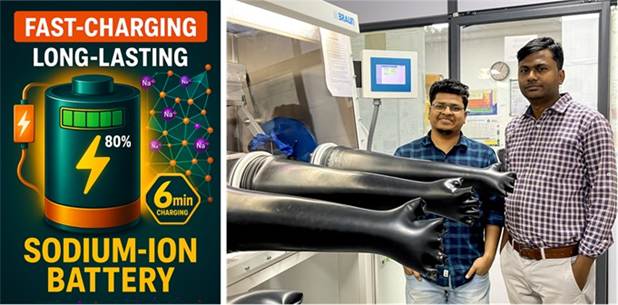
A research team at the Jawaharlal Nehru Centre for Advanced Scientific Research (JNCASR), an autonomous institute of the Department of Science and Technology (DST) has developed a super-fast charging sodium-ion battery (SIB) based on a NASICON-type cathode and anode material, that can charge up to 80% in just six minutes and last over 3000 charge cycles.
Unlike conventional SIBs that suffer from sluggish charging and short lifespan, this new battery uses a clever mix of chemistry and nanotechnology. The scientists led by Prof. Premkumar Senguttuvan and Ph.D. scholar Biplab Patra, engineered a novel material for the anode—Na₁.₀V₀.₂₅Al₀.₂₅Nb₁.₅(PO₄)₃—and optimized it in three critical ways –shrinking the particles to nanoscale, wrapping them in a thin carbon coat, and improving the anode material by adding a small amount of aluminium. These tweaks made sodium ions move faster and more safely, enabling both speed and durability.
Sodium is cheap and abundantly available in India, unlike lithium which is scarce and largely imported. A battery built on sodium instead of lithium could help the country to become self-reliant in energy storage technology—a key goal of the Indian government’s Atmanirbhar Bharat mission.
Beyond just cost, these sodium-ion batteries could power everything from electric vehicles and solar grids to drones and rural homes, making clean energy accessible where it’s needed the most.
The technology has been tested and validated through high-end methods, including electrochemical cycling and quantum simulations. What makes it especially exciting is that it not only supports rapid charging but also avoids the fire and degradation risks of traditional batteries.
While more development is needed before these batteries hit the market, the discovery marks a significant step forward. Peers in the scientific community have begun to take notice, and with continued support, we may soon see India leading the global race in green battery technology.

Nurturing Creativity – Keekli Charitable Trust, Shimla